Macron with a comfortable majority undermined by record low turnout

di

Elie Michel

Emmanuel Macron

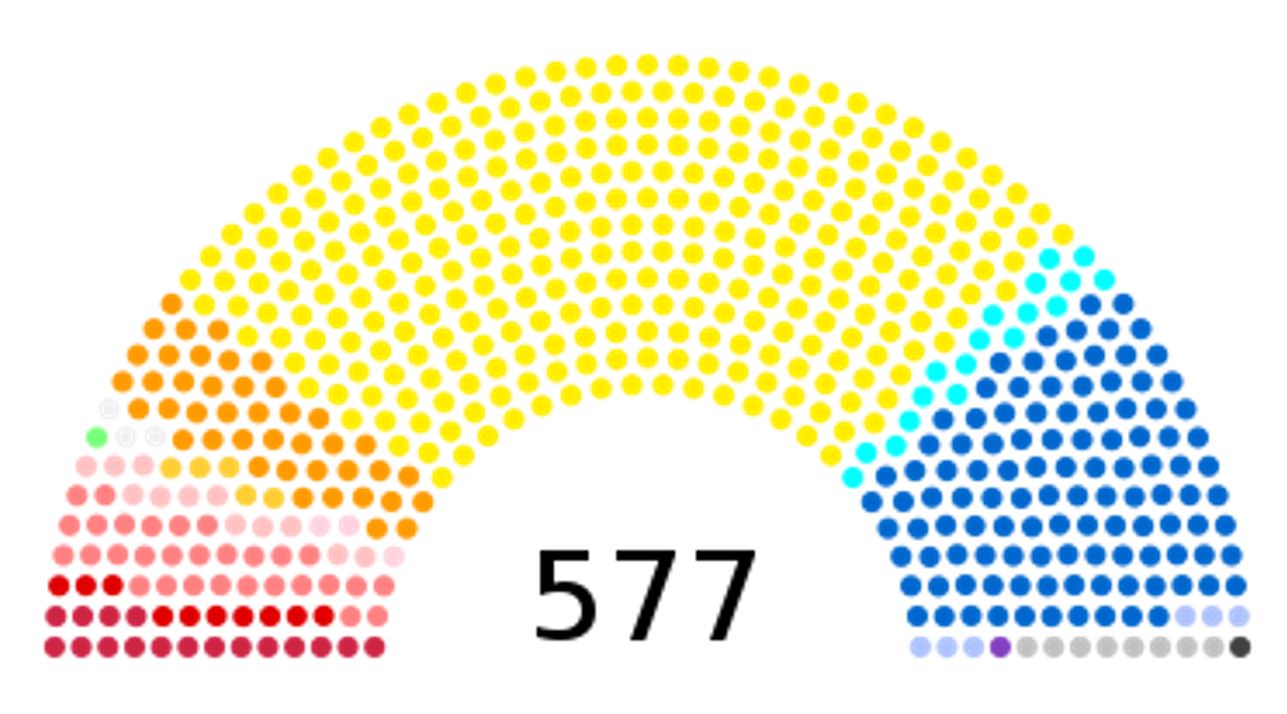
Emmanuel Macron’s presidential majority – consisting of his movement La République En Marche (LREM) and centrist party Modem – has largely win the second round of the legislative elections on June 18, although with a smaller margin than predicted after the first round. LREM on its own has obtained the absolute majority in the lower house with 308 seats out of 577. Mainstream parties of the left and the right realized some of the worst electoral performances in parliamentary elections: the Parti Socialiste (PS) hits a record low, with only 30 MPs, and making a parliamentary group of a little over 40 MPs with its traditional allies. Conservatives (LR) and centre-right obtain 120 members of parliament, although the will seat divided in parliament, as a third of right-wing MPs will support the government whereas the rest stands in the opposition. The radical left, under the lead of Jean-Luc Mélenchon, performs better than expected, with a total of 30 MPs, which have been unable to form a unitary group. The Front National achieves its best score under the two-round majoritarian electoral system, sending 8 representatives to parliament, including party leader Marine Le Pen.

Fig. 1 – Composition of the next National AssemblyGrafico a emiciclo che rappresenta la composizione parlamentare dell'Assemblea Nazionale della Repubblica Francese, con un totale di 577 seggi indicati in cifre nere al centro. Ciascun seggio è raffigurato da un singolo punto colorato, organizzato in file semicircolari concentriche. I colori seguono la disposizione politica da sinistra a destra. Sul lato sinistro si trova la componente di sinistra, formata da file di punti in diverse sfumature di rosso acceso, rosa e arancione scuro, arricchita da un paio di punti di colore verde. Il centro dell'emiciclo è dominato da una vastissima maggioranza di punti di colore giallo brillante, che occupano l'intera sezione centrale e superiore del semicerchio. Proseguendo verso destra, si incontra una linea sottile di punti di colore azzurro e turchese chiaro. Infine, l'ala destra è composta da un fitto blocco di punti di colore blu scuro, completato nell'estremità inferiore destra da una breve fila finale di punti di colore grigio, azzurro molto pallido e un singolo punto nero all'estremità finale.In addition to this unprecedented composition of parliament with a hegemonic centrist majority, flanked by smaller opposition groups on the left and on the right, the low turnout constitutes the historical result of this election. 57.4% of registered voters did not turn out to the polling station for the second round of the election. This is 8% more non-voters than for the first round, and it sets a new historical record. Traditionally, participation is lower in the legislative elections than in the presidential elections, but the ongoing trend suggests that legislative elections have become “second order elections”. Indeed, because they occur 6 weeks after, the legislative elections have become subordinated to the presidential election, which is the most salient. This trend has been steadily increasing since 2002, the first election with a “reversed calendar”, in which legislative serve as a “confirmation election” or a “third round” after the election of the president. The stake of the legislative election is now reduced to “giving a majority” to the freshly elected president. In such cases, the president’s party usually manages to obtain the support of a majority of its voters, while opposition parties are faced with largely demobilized voters. In the legislative elections, the most vocal opponents of Macron, la France Insoumise (LFI, radical left) and the Front National (FN) have only obtained between half and third of the votes they received in the presidential election.
Tab. 1 – Overall electoral results in 2017 French legislative elections Tabella statistica complessa che mostra i risultati definitivi delle elezioni parlamentari francesi per partiti e coalizioni, suddivisi tra primo turno, secondo turno e seggi totali conseguiti, con i dati conclusivi sulla partecipazione elettorale.
Nella sezione dedicata alla maggioranza presidenziale di centro: La République En Marche! ottiene 6.391.269 voti (28.2% e 2 seggi) al primo turno, 7.826.245 voti (43.1% e 306 seggi) al secondo, per un totale di 308 seggi (53.4%). Il Democratic Movement ottiene 932.227 voti (4.1% e 0 seggi) al primo turno, 1.100.656 voti (6.1% e 42 seggi) al secondo, per un totale di 42 seggi (7.3%). Complessivamente, la maggioranza presidenziale raccoglie 7.323.496 voti (32.3% e 2 seggi) al primo turno, 8.926.901 voti (49.1% e 348 seggi) al secondo, arrivando a 350 seggi totali (60.7%).
Nella sezione dedicata alla destra parlamentare: The Republicans ottengono 3.573.427 voti (15.8% e 0 seggi) al primo turno, 4.040.203 voti (22.2% e 112 seggi) al secondo, per un totale di 112 seggi (19.4%). L'Union of Democrats and Independents raccoglie 687.225 voti (3.0% e 1 seggio) al primo turno, 551.784 voti (3.0% e 17 seggi) al secondo, per un totale di 18 seggi (3.1%). La voce Miscellaneous right ottiene 625.345 voti (2.8% e 0 seggi) al primo turno, 306.074 voti (1.7% e 6 seggi) al secondo, per un totale di 6 seggi (1.0%). Complessivamente, la destra parlamentare somma 4.885.997 voti (21.6% e 1 seggio) al primo turno, 4.898.061 voti (27.0% e 135 seggi) al secondo, raggiungendo 136 seggi totali (23.6%).
Nella sezione dedicata alla sinistra parlamentare: il Socialist Party ottiene 1.685.677 voti (7.4% e 0 seggi) al primo turno, 1.032.842 voti (5.7% e 30 seggi) al secondo, per un totale di 30 seggi (5.2%). La voce Miscellaneous left registra 362.281 voti (1.6% e 1 seggio) al primo turno, 263.488 voti (1.5% e 11 seggi) al secondo, per un totale di 12 seggi (2.1%). Il Radical Party of the Left raccoglie 106.311 voti (0.5% e 0 seggi) al primo turno, 64.860 voti (0.4% e 3 seggi) al secondo, per un totale di 3 seggi (0.5%). Complessivamente, la sinistra parlamentare raccoglie 2.154.269 voti (9.5% e 1 seggio) al primo turno, 1.361.190 voti (7.5% e 44 seggi) al secondo, attestandosi a 45 seggi totali (7.8%).
Per gli altri partiti e liste singole, i dati combinati mostrano: La France insoumise ottiene l'11.0% al primo turno e il 4.9% al secondo, conquistando 17 seggi totali (3.0%). Il French Communist Party raccoglie il 2.7% al primo turno e l'1.2% al secondo, per 10 seggi totali (1.7%). Il National Front registra il 13.2% al primo turno e l'8.8% al secondo, ottenendo 8 seggi totali (1.4%). I Regionalists ottengono 5 seggi totali (0.9%), la voce Miscellaneous consegue 3 seggi totali (0.5%), gli Ecologists ottengono 1 seggio (0.2%), Debout la France ottiene 1 seggio (0.2%) e la Far-right ottiene 1 seggio (0.2%). La voce Far-left registra lo 0.8% al primo turno senza ottenere alcun seggio.
Il riepilogo generale del voto valido riporta 22.654.164 schede (100.0% e 4 seggi assegnati) al primo turno e 18.176.066 schede (100.0% e 573 seggi assegnati) al secondo turno, definendo l'assegnazione finale di tutti i 577 seggi dell'assemblea. I dati conclusivi sulla partecipazione mostrano per il primo turno: voti validi 97.8%, schede bianche 1.5%, schede nulle 0.7%, affluenza 48.7%, astensione 51.3% su 47.570.988 elettori iscritti. Per il secondo turno si registrano: voti validi 90.1%, schede bianche 7.0%, schede nulle 2.9%, affluenza 42.6%, astensione 57.4% su un totale di 47.293.103 elettori iscritti.

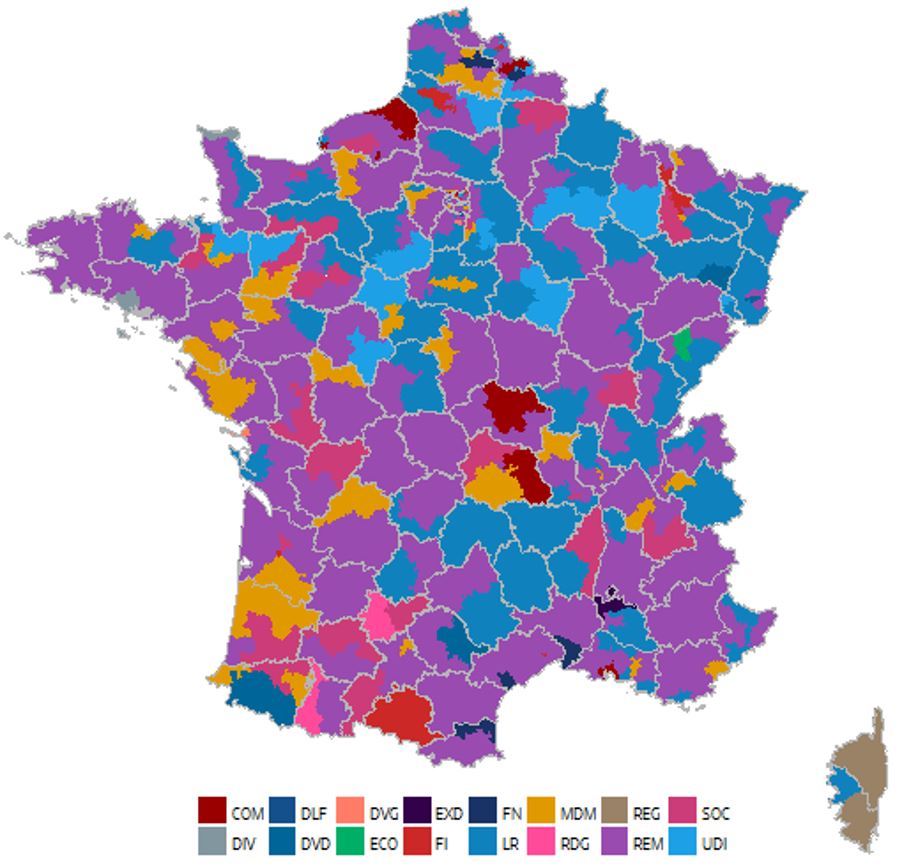
Particularly, each party’s electoral gains is geographically polarized. The radical left has obtained its biggest gain in the former socialist “banlieues” of Paris, while the mainstream right resisted in its traditional strongholds in the East of the country. 5 out of the 8 Front National MPs are elected in the former coal mining districts of the North. LREM, as a new party, has gained MPs all over the country, but clearly establishes its electoral stronghold in the Western part of the country, and particularly in the Bretagne region, which elected 24 LREM MPs out of 27.

Fig. 2 – Map of the district winner in 2017 French legislative electionsMappa geopolitica della Francia che mostra la distribuzione dei risultati elettorali nei diversi collegi legislativi, colorati in base al partito o alla coalizione vincente. In basso è presente una legenda orizzontale su due righe che associa ciascuna sigla politica a un quadrato colorato. Nella prima riga della legenda troviamo: COM in rosso scuro, DLF in blu scuro, DVG in arancione chiaro, EXD in viola scuro, FN in grigio chiaro, MDM in giallo ocra, REG in marrone e SOC in rosa scuro. Nella seconda riga della legenda figurano: DIV in grigio scuro, DVD in azzurro scuro, ECO in verde, FI in rosso acceso, LR in blu, RDG in fucsia, REM in viola e UDI in celeste. Sul territorio nazionale, il colore viola legato alla sigla REM predomina in modo diffuso e massiccio, coprendo la stragrande maggioranza delle aree dal nord al sud e dal centro alle coste. I collegi rimasti si dividono in aree alternate: il blocco di colore blu associato a LR spicca in vari collegi del nord-ovest, del centro e del sud-est; le tonalità ocra di MDM appaiono sparse principalmente nel quadrante occidentale; la sigla FI in rosso acceso si nota in piccoli nuclei urbani e zone specifiche del centro-sud; mentre le sfumature rosa di SOC resistono in alcuni collegi meridionali. L'isola della Corsica, posizionata in basso a destra, è colorata in marrone per la sigla REG nella parte nord-orientale e in azzurro scuro per la sigla DVD nella parte sud-occidentale.
LREM’s majority in parliament gives Emmanuel Macron and its government a comfortable margin to lead the economic reforms promised during the campaign. But this political lead is certainly undermined by the high abstention, which appears to be both structural and political. In addition to the usual 15-20% of non-voters, 2017 seems to have been marked by a political abstention, a form of protest through non-voting. The call of some leaders of the left not to choose between Macron and Le Pen in the second round of the presidential election seems to have had consequences in the legislative elections. In addition to record abstention, blank or null votes also skyrocketed. In the second round of the legislative elections, 1,3 million voters cast a blank vote (about 7% of the votes). (newportworldresorts.com) Strikingly, the blank votes increased by a million between the two-round, clearly showing that many voters intended to protest against the political offer of the second round. Overall, the LREM’s majority is large, and stable, but it will always face a legitimacy concern, because the combination of low turnout in a majoritarian system make it one of the most badly elected majority in Europe. Further, these results ask question about the equilibrium of the institutions, and the role of legislative elections. It is a democratic issue when the elections that determine the political majority in parliament are devaluated to this point.