




Autore: Redazione CISE

  • Patronage and Elections in U.S. States

    American Political Science Review 01 August 2011 105: 567-585

    Autori: Olle Folke; Shigeo Hirano; James M. Snyder Jr

    Does control of patronage jobs significantly increase a political party’s chances of winning elections in U.S. states? We employ a differences-in-differences design, exploiting the considerable variation in the dates that different states adopted civil service reforms. Our evidence suggests that political parties in U.S. states were able to use state-level patronage to increase the probability of maintaining control of state legislatures and statewide elective offices. We also find that an “entrenched” party, in power for a longer time, can use patronage more effectively. We consider several alternative hypotheses that might plausibly account for the patterns in the data, but find no evidence to support them.

  • Papers and presentations from the “Revisiting Party Identification” conference are now online

    Papers and presentations from the “Revisiting Party Identification” conference are now online

    Panel 1:

    David W. Brady and Arjun  S. Wilkins
    Secular realignment in the United States 1937-2010: a preliminary analysis

    Samuel J. Abrams and Morris P. Fiorina
    Are leaning independents deluded or dishonest weak partisans?

    Douglas Rivers
    Party identification in the US over the electoral cycle

    Panel 2:

    Roberto D’Alimonte, Lorenzo De Sio and Nicola Maggini
    Party identification and party system change: Italy between the First and the Second Republic

    Hermann Schmitt and Paolo Segatti
    Political parties, left-right orientations and the vote in Italy, France and Germany

    Panel 3:

    Piergiorgio Corbetta and Pasquale Colloca
    Political orientation in times of crisis in Italy: the consequences of job precariousness

    Radoslaw Markowski
    Idiosyncrasies of party identification in new democracies: the case of Central & Eastern Europe

    Panel 4:

    Bruno Cautres
    A view on party identification from France : substantive and methodological considerations

    Adriaan Luyten and Chistophe Crombez
    Party Loyalty in Belgium and Germany: The Effects Of Consumer Confidence and Government Approval

    Panel 5:

    Cees Van der Eijk
    Party Identification and PTVs

    Hans M.A. Schadee and  Cristiano Vezzoni
    Options for party identification: questions in multiparty systems

    Panel 6:

    Donald P. Green
    Breaking empirical deadlocks in the study of partisanship: an overview of experimental research strategies

    Jacques Thomassen and Martin Rosema
    Party identification revisited

  • Do Democracies Select More Educated Leaders?

    American Political Science Review 01 August 2011 105: 552-566

    Autori: Timothy Besley; Marta Reynal-Querol

    This paper uses a unique data set on over 1,400 world leaders between 1848 and 2004 to investigate differences in educational qualifications between leaders who are selected in democracies and autocracies. After including country and year fixed effects, we find that democracies are around 20% more likely to select highly educated leaders. This finding is robust to a wide range of specifications, choices of subsamples, controls, and ways of measuring education and democracy.

  • Deliberation with Evidence

    American Political Science Review 01 August 2011 105: 516-529

    Autore: Jérôme Mathis

    In committee deliberation, requiring a unanimous vote intuitively provides the strongest incentives for actors to share fully their opinions and private information. It is also believed that full revelation of (decision-relevant) information occurs when personal biases are made clear before deliberation. However, recent literature suggests that both intuitions are flawed. Austen-Smith and Feddersen propose a model in which the unanimity rule performs worse than other rules in promoting fully revealing deliberation, and uncertainty about individuals’ preferences promotes full sharing of information. We extend this work by incorporating the possibility that individuals may provide verifiable evidence for their private information. Under this circumstance, we demonstrate that Austen-Smith and Feddersen’s results are reversed. First, a unanimous voting rule performs better than any other, as unanimity is the only rule that always promotes fully revealing deliberation. Second, under fairly general conditions, uncertainty about individuals’ preferences prevents full sharing of information.

  • Elite Influence on Public Opinion in an Informed Electorate

    American Political Science Review 01 August 2011 105: 496-515

    Autore: John G. Bullock

    An enduring concern about democracies is that citizens conform too readily to the policy views of elites in their own parties, even to the point of ignoring other information about the policies in question. This article presents two experiments that undermine this concern, at least under one important condition. People rarely possess even a modicum of information about policies; but when they do, their attitudes seem to be affected at least as much by that information as by cues from party elites. The experiments also measure the extent to which people think about policy. Contrary to many accounts, they suggest that party cues do not inhibit such thinking. This is not cause for unbridled optimism about citizens’ ability to make good decisions, but it is reason to be more sanguine about their ability to use information about policy when they have it.

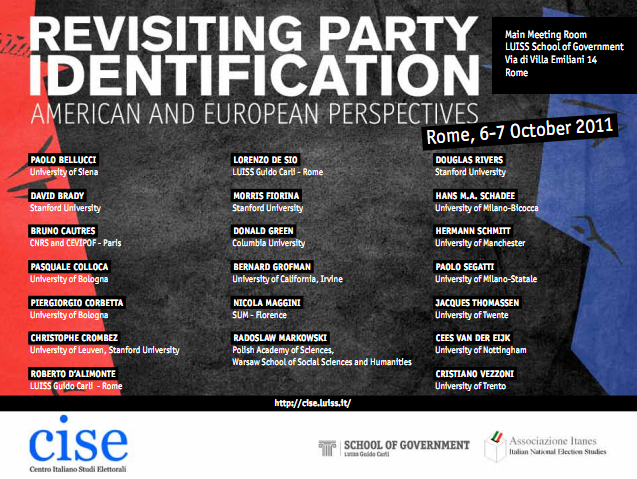
  • Revisiting Party Identification: American and European Perspectives

    Revisiting Party Identification: American and European Perspectives

    An international scientific conference organized by the CISE, in collaboration with the LUISS School of Government and the ITANES Association – Italian National Election Studies.

    Rome, 6-7 October 2011

    Main Meeting Room
    LUISS School of Government
    Via di Villa Emiliani 14

    Participants:

    Paolo Bellucci
    University of Siena

    David Brady
    Stanford University

    Bruno Cautres
    CNRS and CEVIPOF – Paris

    Pasquale Colloca
    University of Bologna

    Piergiorgio Corbetta
    University of Bologna

    Chistophe Crombez
    University of Leuven, Stanford University

    Roberto D’Alimonte
    LUISS Guido Carli  – Rome

    Lorenzo De Sio
    LUISS Guido Carli – Rome

    Morris Fiorina
    Stanford University

    Donald Green
    Columbia University

    Bernard Grofman
    University of California, Irvine

    Nicola Maggini
    SUM – Florence

    Radoslaw Markowski
    Polish Academy of Sciences, Warsaw School of Social Sciences and Humanities

    Douglas Rivers
    Stanford University

    Hans M.A. Schadee
    University of Milano-Bicocca

    Hermann Schmitt
    University of Manchester

    Paolo Segatti
    University of Milano-Statale

    Jacques Thomassen
    University of Twente

    Cees Van der Eijk
    University of Nottingham

    Cristiano Vezzoni
    University of Trento

    The full programme of the conference is available here.

  • The Ideological Mapping of American Legislatures

    American Political Science Review 01 August 2011 105: 530-551

    Autori: Boris Shor; Nolan McCarty

    The development and elaboration of the spatial theory of voting has contributed greatly to the study of legislative decision making and elections. Statistical models that estimate the spatial locations of individual decision-makers have made a key contribution to this success. Spatial models have been estimated for the U.S. Congress, the Supreme Court, U.S. presidents, a large number of non-U.S. legislatures, and supranational organizations. Yet one potentially fruitful laboratory for testing spatial theories, the individual U.S. states, has remained relatively unexploited, for two reasons. First, state legislative roll call data have not yet been systematically collected for all states over time. Second, because ideal point models are based on latent scales, comparisons of ideal points across states or even between chambers within a state are difficult. This article reports substantial progress on both fronts. First, we have obtained the roll call voting data for all state legislatures from the mid-1990s onward. Second, we exploit a recurring survey of state legislative candidates to allow comparisons across time, chambers, and states as well as with the U.S. Congress. The resulting mapping of America’s state legislatures has great potential to address numerous questions not only about state politics and policymaking, but also about legislative politics in general.

  • Party Preferences and Electoral Reform: How Time in Government Affects the Likelihood of Supporting Electoral Change

    West European Politics, Volume 34, Number 3, May 2011 , pp. 568-586(19)

    Autori: Jean-Benoit Pilet; Damien Bol

    Most of the literature asserts that political parties rationally define their preference for electoral reform with respect to their possible gains and the balance of power between and within parties. Other scholars moderate this rationality, underlining the role of the uncertainty inherent to any change in the electoral system. This article shows how risk and expected gains interact. Through an analysis of the preferences of 84 parties in 13 different electoral reform debates, it shows that risk impedes parties from supporting even advantageous change. However, it also points out that not all parties are equally sensitive to risk. Parties that are dissatisfied with the current system are more willing to favour a reform from which they expect gains. In other words, dissatisfaction makes parties more seat-maximising.

  • When Electoral Reform Fails: The Stability of Proportional Representation in Post-Communist Democracies

    West European Politics, Volume 34, Number 3, May 2011 , pp. 607-625(19)

    Autore: Csaba Nikolenyi

    This article examines the failure of three attempts to replace proportional representation with a majoritarian alternative in post-communist Eastern Europe: Slovenia in 1996; the Czech Republic in 2000; and Romania in 2008. The central argument of the article is that majoritarian electoral reform is both incompatible with and prevented by the institutions of consensus democracy. The constitutional design of consensus democracy creates multiple veto points and veto players that limit major policy and legislative change, such as electoral reform. As such, they also provide for self-enforcing stability in the electoral system by making it very difficult for political actors to build a winning coalition to reform it.

  • The Different Trajectories of Italian Electoral Reforms

    West European Politics, Volume 34, Number 3, May 2011 , pp. 644-663(20)

    Autore: Gianfranco Baldini

    Italy is the only established democracy where two major electoral reforms took place inthe last 20 years (respectively in 1993 and 2005). Adopting Renwick’s approach, which distinguishes between elite majority imposed and elite-mass interaction reforms, the article analyses electoral reforms in Italy in the post-World War II period. By examining the long-term importance of electoral rules in Italian politics, it argues that PR played a uniquely fundamental role in shaping both the so-called Italian ‘First Republic’ and the still unfulfilled transition towards a reformed political system. (Valium) By focusing on the main determinants which brought about the two most recent reforms, it becomes apparent that, in the last two decades, the ever-changing party system format contributes to the cyclical salience of electoral reform as a possible means of accomplishing the never-ending transition towards a more stable political settlement.